
Our Subcluster Models Provide Insights into Mamdani’s 2025 Election
When exploring modern Democratic politics, there are two general categories: a moderate group focused on implementing changes within an existing system, and progressives focused on deep, structural change. This fundamental division within the Democratic party has shaped the landscape of elections in recent years, including the upcoming 2026 midterm elections.
Determined to flip the House and the Senate, the party has been doing everything in its power to bring a potential “blue wave” to shore by attempting to guarantee success on the notion of electability. Democrats have been pushing for a strong candidate that would raise turnout enough to curb stomp any GOP effort. This, therefore, introduces the question of defining an “electable candidate.”
Democrats are divided on what “electable” looks like; while progressives argue that voters will be energized by bold ideas that depart from the status quo of mainstream Democratic politics, moderates argue that progressives are “too radical” for voters in general elections.
To investigate, we took a look at a recent and well-publicized progressive success story: the 2025 NYC mayoral election that brought Democratic Socialist Zohran Mamdani into office. Of course, winning a local race with a strong independent candidate in overwhelmingly blue New York City is very different from winning a national race in a purple state. But our cluster models can still help us identify the characteristics and interests of voters that turned out for Mamdani, and find voters that meet this profile across the country.
Haystaq’s cluster and subcluster models, built using scores from our national models and machine learning, push beyond the traditional boundaries of party identification, age, and ethnicity to split American voters into 21 subcategories, defined by their voting behavior and issues they most closely align with (check out a full description of all of our clusters here). With every voter on our file classified, we analyzed the 2025 mayoral election turnout by cluster and subcluster.
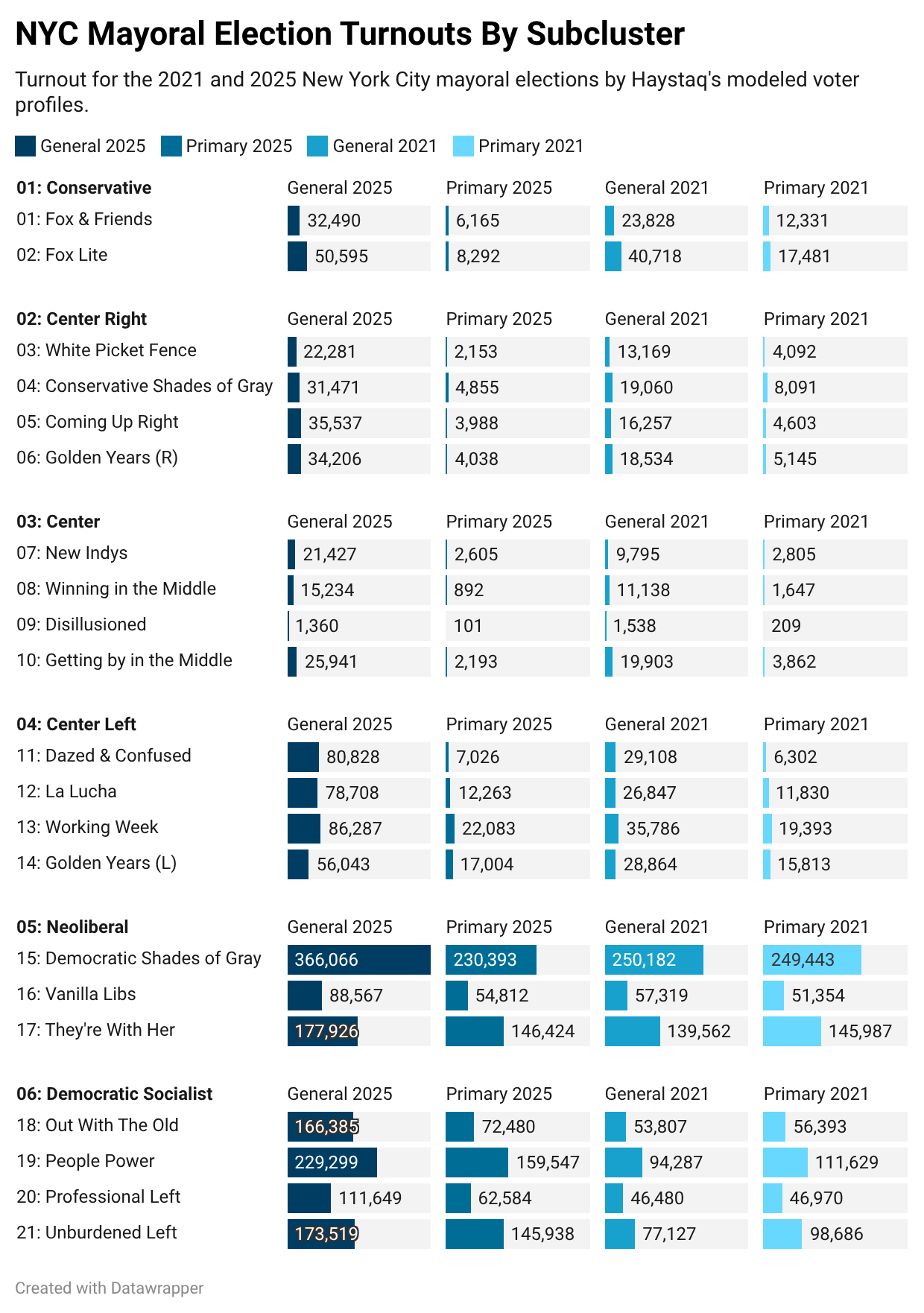
Image: The image above shows turnout for the 2025 and 2021 New York City mayoral elections respectively, as well as changes in turnout between the elections. Check out all of our subcluster descriptions here!
Looking first at the increase in turnout from 2021 to 2025 general elections, both the Democratic Socialist cluster and Center Left cluster saw huge increases. Among these, two subclusters stand out from the rest: La Lucha, a predominantly Latine subcluster that values economic policies aimed at helping working people, experienced a 193% increase; and Out With The Old, a predominantly young and non-white subcluster broadly supportive of liberal policies and critical of capitalism, experienced a 209% increase. Both groups are low income and traditionally low turnout, but in 2025 they pulled up to the polls in unprecedented numbers, with Out With The Old voters jumping from a relatively small portion of voters to the fifth largest subcluster in the city.
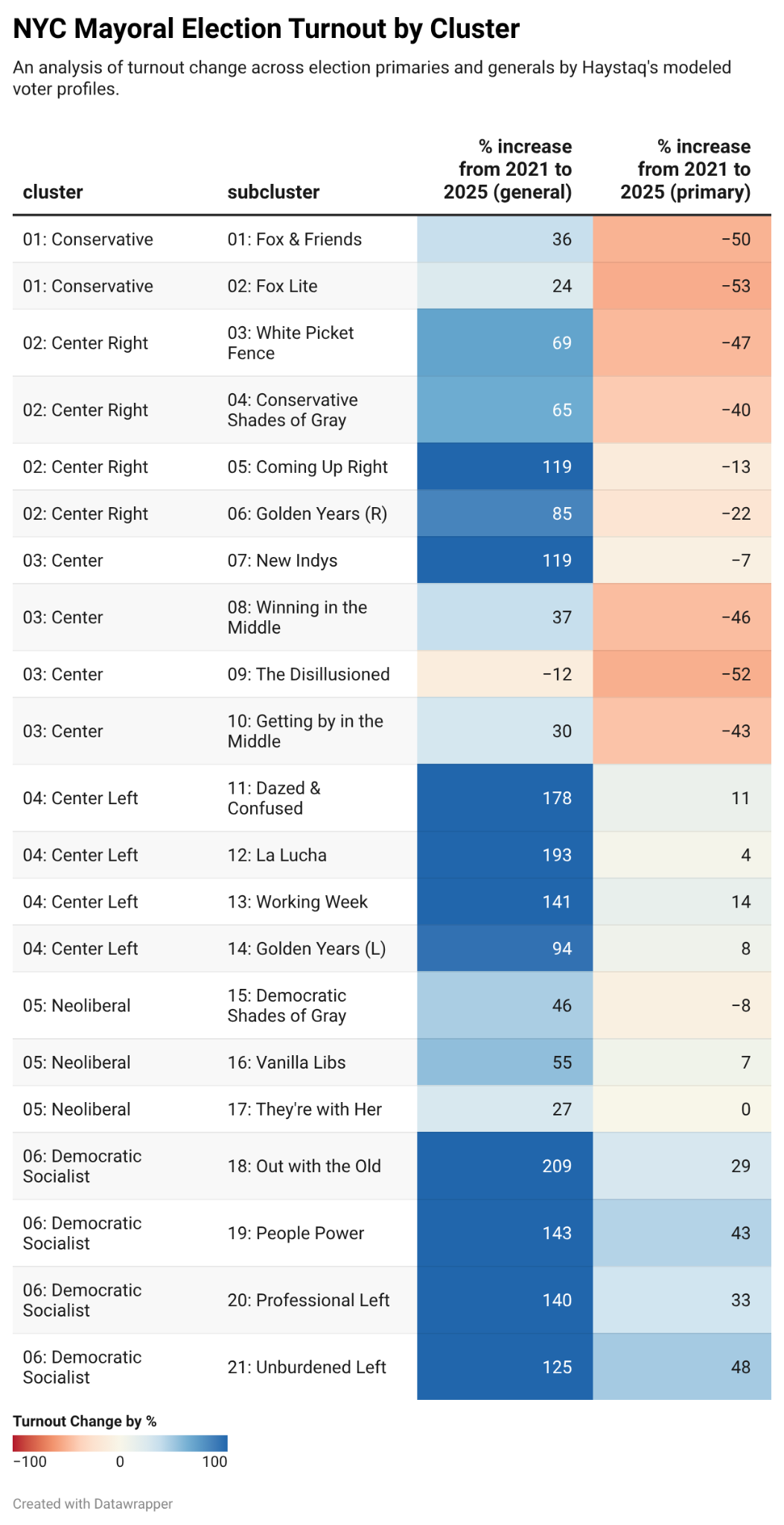
Image: The image above shows the change in turnout by subcluster between the 2025 and 2021 New York City mayoral elections.
The data suggest that Mamdani activated multiple low-turnout groups in record numbers for the election by running on popular progressive policies related to affordability, justice, and public services. His race also presents a potential roadmap for other progressives running for office this November: progressive policies are popular amongst voters, and are successful given the right platform. This suggests that, at least in New York, a candidate’s electability does not hinge on how “progressive” or “moderate” they are, but rather how effectively their policies speak to voters’ frustrations, fears, and hopes.
If your campaign is looking to appeal to these voters and more, our subcluster models offer unique microtargeting insights that can help your progressive candidate win in November. Our national model scores on affordability, capitalism disillusionment, universal income support, and other economic issues important to working-class voters can also help your campaign find GOTV targets, develop effective digital messaging, and speak to voters about issues that actually matter to them. Let us help you find your audience’s subclusters and bring them to the polls, from New York City to the rest of the nation.
Have questions or want to talk strategy?
Call us at 202-548-2562
We’d love to help you put these insights to work.
Track the evolving political landscape with insights delivered straight to your inbox


Copyright (C) 2026 HaystaqDNA. All rights reserved.
Our mailing address is:
Haystaq DNA
1328 Florida Avenue NW 2nd Floor
Washington, DC 20009
Leave a Reply