
The killing this month of Renée Nicole Good, a 37-year-old mother of three, by an ICE agent has renewed the conversation about the deployment of federal agents and National Guard troops to cities across the country. Good was fatally shot by a federal immigration officer during an enforcement operation in Minneapolis, sparking protests and widespread criticism of federal tactics.
With reports that thousands of additional federal agents are slated to be sent to the state, leaders like Minnesota Governor Tim Walz and Minneapolis Mayor Jacob Frey have again called for the removal of these officers, arguing that the federal presence has inflamed tensions and undermined local trust.
With states like California and Illinois successfully challenging federal attempts to deploy National Guard troops, other states have begun accelerating their own efforts to challenge these deployments. Public opinion on many key issues like the immigration process, military deployment, and civil liberties help assess voter sentiment on this struggle between state and federal officials.
Below, we see that a majority of the Minneapolis voting population perceives the immigration process as unfair. This assessment is based on Haystaq percentile scores, where values from 50–100 indicate voters more likely to oppose the current immigration process, and values from 0–49 indicate voters more likely to support it.
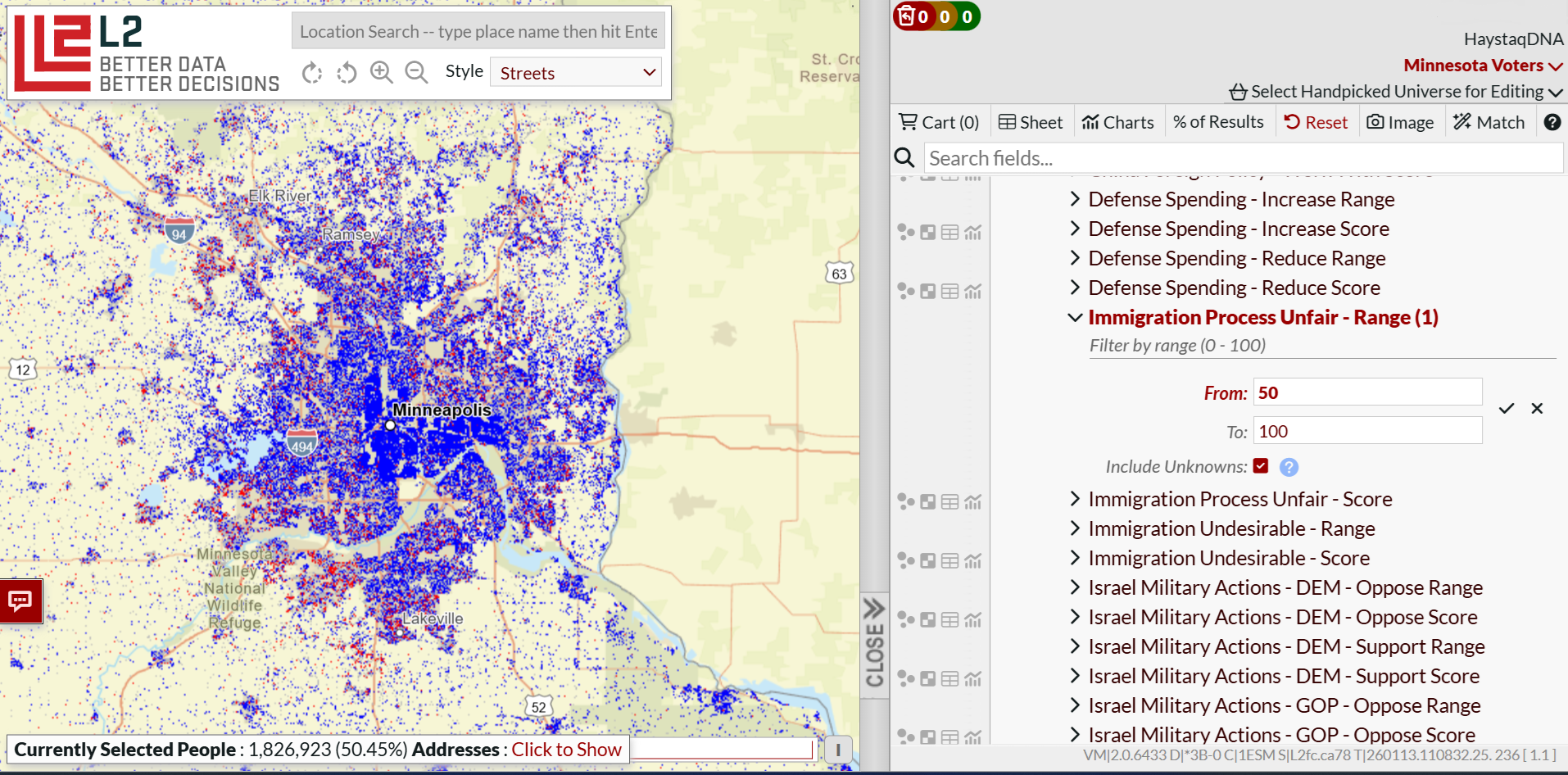
At the statewide level, the 1.8 million voters reflected in the 50–100 range represent roughly half of Minnesota’s total voting population, serving as a baseline for comparison. When examining Hennepin County specifically, 521,422 voters score above 50 on the immigration unfairness index, compared to 280,321 voters who score below 49. This 2:1 disparity underscores the unpopularity of the current administration’s immigration policy.
In 2023 Haystaq created an ICE Score, which predicted whether or not someone felt that the agency had gone too far and should be abolished. The score had a national average of 34.25 showing low national support for the measure. While Minnesota was below the national average at 33.8, Minneapolis stood out with a score of 55.6, indicating greater opposition to ICE even before recent events.
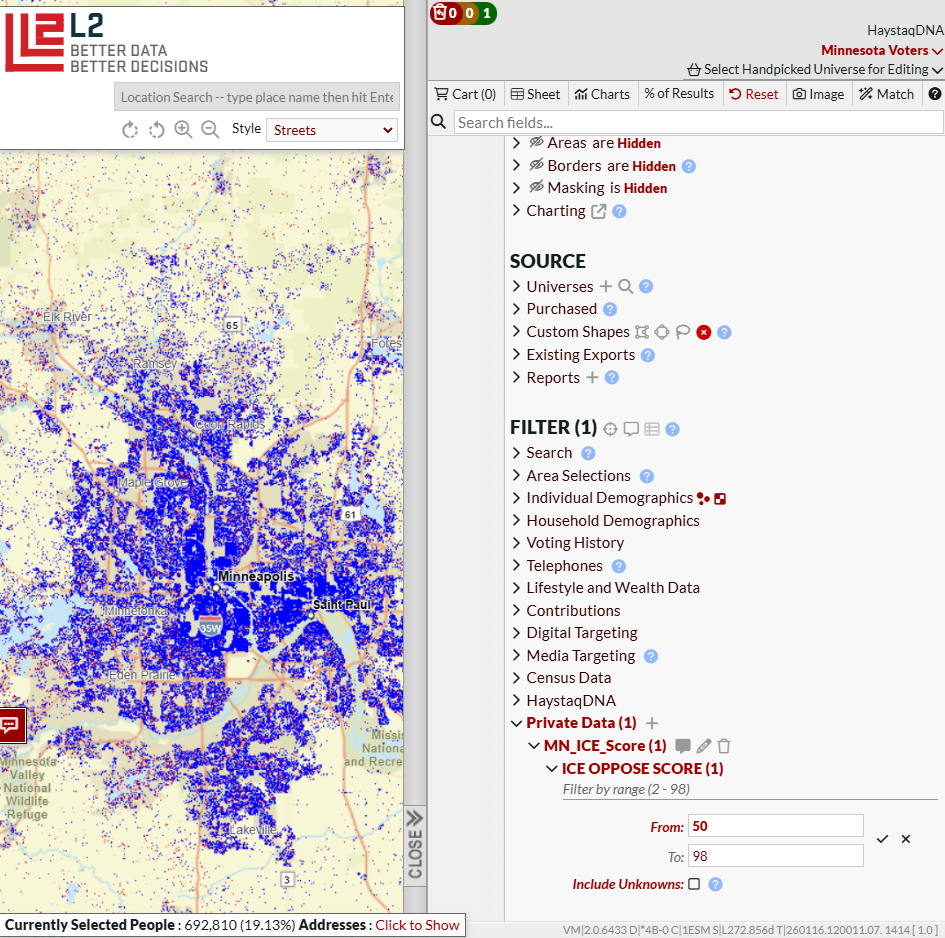
Whether you’re running a campaign, organizing a movement, or building smarter outreach, Haystaq’s models offer a deeper and more actionable understanding of today’s voters. Contact us now for more information.
Click here for the National Models User Guide 2025
Have questions or want to talk strategy?
Call us at 202-548-2562
We’d love to help you put these insights to work.
Track the evolving political landscape with insights delivered straight to your inbox


Copyright (C) 2026 HaystaqDNA. All rights reserved.
Our mailing address is:
Haystaq DNA
1328 Florida Avenue NW 2nd Floor
Washington, DC 20009
Leave a Reply